Beyond books and databases: what a reference meeting at Grainger taught me about why librarianship needs both.
Where I first heard “librarians of things”#
The first time I heard the phrase “librarians of things and librarians of people” was at a reference meeting at the Grainger Engineering Library Information Center at the University of Illinois Urbana-Champaign, where I work as a graduate assistant. It was said almost in passing, the way good ideas often are in staff meetings. But it stuck with me for the rest of the week.
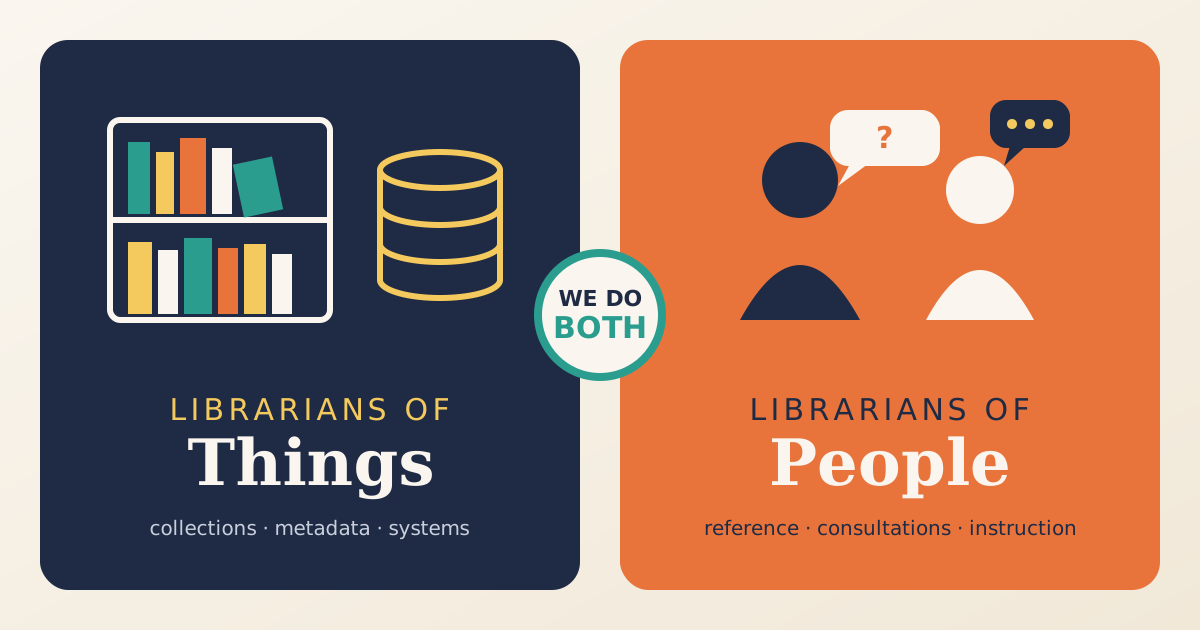
The idea is simple. Some of us are drawn to the things of librarianship: the collections, the databases, the metadata, the systems that make information findable. Others are drawn to the people: the student at the desk, the faculty member stuck on a literature search, the conversation that turns a vague question into a real one.
In this post I want to unpack the phrase, trace where its ideas come from in our professional literature, and explain why I think the most useful answer to “which one are you?” is “both, on purpose.”
What are librarians of things and librarians of people?#
A librarian of things finds meaning in building and caring for the information itself. Their question is: is the right material here, described well, and reachable? Cataloguers, collection developers, systems and electronic resources librarians, archivists, and digital repository managers often (not always) live here.
A librarian of people finds meaning in the human encounter with information. Their question is: what does this person actually need, and how do I help them get there? Reference, instruction, outreach, liaison, and UX work often live here.
| Librarian of things | Librarian of people | |
|---|---|---|
| Starts from | The collection or system | The person and their problem |
| Measures success by | Coverage, accuracy, access, findability | Understanding, confidence, a question resolved |
| Typical work | Cataloguing, metadata, licensing, collection development, discovery systems | Reference interviews, consultations, instruction, outreach |
| Risk when taken too far | A perfect collection nobody uses | Warm help built on a weak foundation |
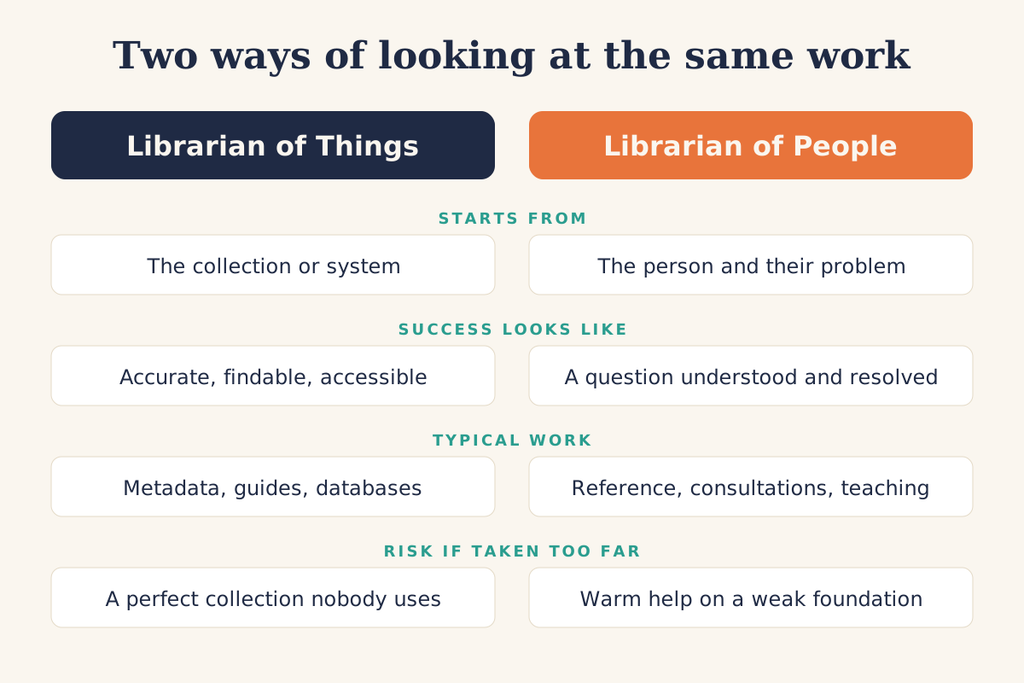
Neither column is the “real” librarian. The phrase is a mirror, not a ranking: it helps you notice which way you naturally lean.
One thing worth saying clearly: these are not official categories the profession recognizes. They are two ways of looking at the same work.
Being a librarian of people is not necessarily about having more conversations with users. It is about keeping people at the center of the decisions we make.
Roots in library science: Ranganathan, Taylor, Kuhlthau, and Lankes#
As far as I can tell, “librarians of things / librarians of people” is not a term coined in one famous article. It is professional shorthand that circulates in conversation. But the tension it names runs through almost a century of library thinking.
Ranganathan: things in service of people (1931)#
S. R. Ranganathan’s Five Laws of Library Science (1931) is a good starting point because it holds both sides at once. “Books are for use” and “Every book its reader” are about things. “Every reader his or her book” and “Save the time of the reader” are about people.
Ranganathan never treated these as rival camps. The collection exists for the reader. Later critics such as Carr (2014) have argued that some of the laws still lean library-centred, and that we should read them from the user’s side.
Taylor: the question behind the question (1968)#
Robert S. Taylor’s “Question-Negotiation and Information Seeking in Libraries” (1968) is the classic people-side text. He showed that the question a patron first asks is rarely the real need. The real need has to be drawn out through conversation, which is why the reference interview became a core skill.
Kuhlthau: the feelings in the search (1991, 2004)#
Carol Kuhlthau’s Information Search Process model described research as a process of thoughts, feelings, and actions, not just retrieval. Her key insight for librarians is that rising uncertainty marks a “zone of intervention”: the moment human help matters most (Kuhlthau, 2004).
Constance Mellon’s work on library anxiety (1986) points the same way. Many students feel lost or ashamed in the library, and a helpful person can change that faster than a better shelf layout.
Lankes: from collections to communities (2011, 2012)#
R. David Lankes made the shift explicit. In The Atlas of New Librarianship (2011), he put the mission plainly: “The mission of librarians is to improve society through facilitating knowledge creation in their communities”. His widely shared line from Expect More (2012) puts it bluntly: bad libraries build collections, good libraries build services, great libraries build communities.
Lankes is careful here. He does not say collections are bad; he says a collection is one service among many. That nuance is exactly where the “things vs. people” debate gets interesting.
Reference, consultations, and instruction at Grainger: we do both#
Here is the thing that made the phrase land for me: at the Grainger Engineering Library, nobody gets to be only one or the other. In the same week, the same small team answers reference questions, sits down for research consultations, teaches instruction sessions, and maintains the guides, databases, and collections that make all of that possible.
A typical week, both hats on#
At the reference desk (people). A student walks up and asks for “something on concrete.” Five minutes of conversation later, it turns out they need the ASTM standard their lab instructor mentioned and have no idea standards live in a separate database. The question they asked was not the question they had.
In a research consultation (people). A grad student books an hour because their literature review keeps returning either 12 results or 12,000. We build a search strategy together: keywords, synonyms, the right database for their field, and when to stop. They leave less anxious, not just with a list of articles.
In an instruction session (people). A first-year engineering class gets a short session on finding standards, patents, and technical reports. The goal is not to show every database. It is to make sure that when they hit a wall at 11 p.m., they know where to look and that asking a librarian is normal.
Behind the scenes (things). Between all of that, someone is updating a LibGuide, checking that a handbook link still resolves, describing a database clearly enough that a tired student can tell what it is for, or making sure a page works with a screen reader. Right now I am building a LibGuide on engineering handbooks, and it is pure “things” work that only matters because of the people who will use it.
Why they cannot be separated#
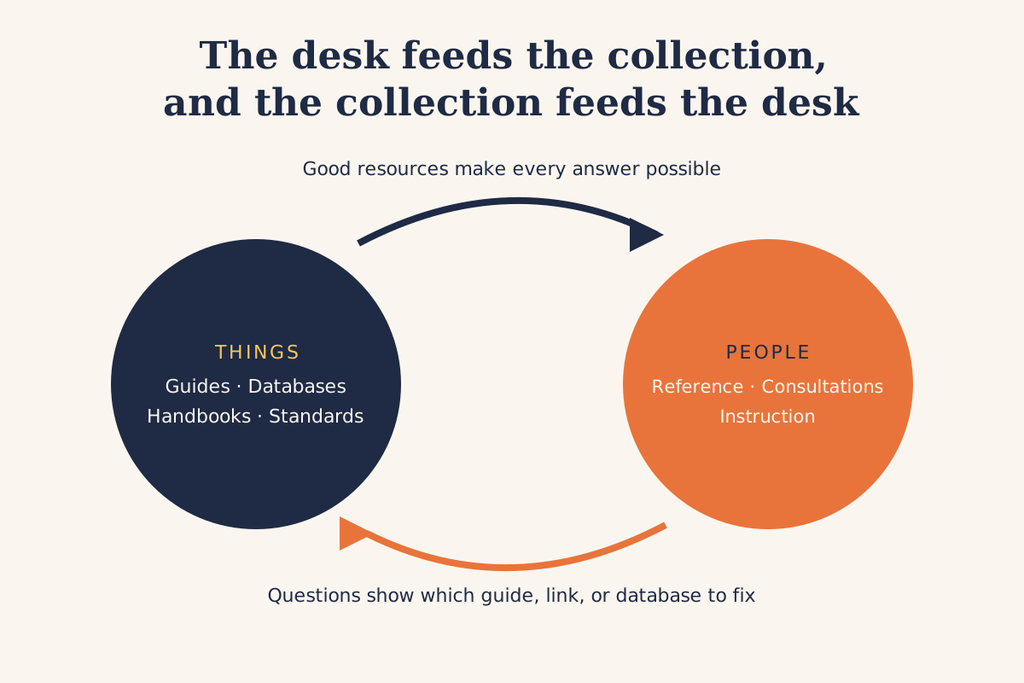
Every one of those people moments depends on a things moment. The reference answer only works because the standards database is licensed and findable. The consultation only works because the guide we point to is current. The instruction session only sticks because the tools we demo actually behave the way we say they do.
And it runs the other way too. The questions we hear at the desk are how we know which guide is confusing, which link is broken, or which database students never discover. At Grainger, the desk feeds the collection, and the collection feeds the desk.
Why it’s a lean, not a label#
The phrase is most useful as a description of where your energy goes, not as a fixed identity. Three reasons convinced me of this.
Thing work is people work in disguise. A cataloguer who writes clear subject headings is saving the time of a reader they will never meet. Accessible metadata, alt text, and clean discovery interfaces are care for people, delivered through things. My own work in digital accessibility and UX sits right on this line.
Here is an example from my own work on library web content. A research guide can list excellent resources, but if they sit inside a complex table that a screen reader cannot navigate, the information exists and is still out of reach. Accessibility is not a feature you add at the end; it shapes how we design and describe information from the start.
People work needs things to stand on. A friendly reference interview that ends at a paywall or a broken link is a disappointment, not a service. Warmth cannot replace a good collection.
Technology is blurring the line. With AI tools, discovery layers, and self-service systems, much “thing” work now shapes the user’s experience directly. Meanwhile, people-facing librarians increasingly teach others how to judge systems and sources. Both roles now need to understand the other.
So the healthiest version of the idea is this: know your lean, value the other side, and build bridges between them on your team.
The ALA’s Core Values of Librarianship point the same way. Values like access, equity, and the public good apply whether you are cataloguing a collection or teaching a workshop.
Wait, isn’t a “Library of Things” something else?#
Yes, and it is worth separating the two. A Library of Things is a lending program where libraries loan out objects like tools, musical instruments, cameras, sewing machines, or board games. It is not the same as being a “librarian of things” in the sense I am using here.
In fact, a Library of Things is a good example of people-centered work. Nobody collects a lawn mower for its own sake; it is there because a neighbor needs one for a weekend and cannot afford to buy it. The things exist to open doors for people.
Why AI makes this question more urgent#
AI tools are now part of how students and researchers look for information. Conversational search, AI summaries, and recommendation systems can save time, but they also raise real questions about accuracy, transparency, and trust.
A purely “things” response to AI is to focus on the tools: which ones to license, which features to turn on, how well they perform. Those are fair questions, but they are not the whole story.
A people-centered response asks different ones:
- Can users tell verified evidence apart from a confident but wrong answer?
- Do they know when to go back to the original source?
- Are these tools accessible to people with different abilities and levels of digital literacy?
- How do they shape a person’s trust in what they read?
These questions matter to me personally, because my research interests sit right here: AI-mediated information seeking, user trust, and verification. I think librarians have a real role to play. Our job does not end with providing access to an AI tool. It includes helping people understand what it can do, where it fails, and why checking still matters.
So, am I a librarian of things or of people?#
If I am honest, I will say i am both but I lean toward people. The reference desk is where the work feels most alive to me. But my technical background and desire to always build and fix things keeps pulling me back to things: how a page is structured, how a database is labelled, whether a screen reader can get through a guide.
Maybe that is the real lesson from that Grainger meeting. The phrase is not asking us to pick a side. It is asking us to notice who we tend to forget.
A few questions to sit with:
- When you picture a good day at work, are you holding a resource or talking with someone?
- Which kind of work do you tend to undervalue in your colleagues?
- What is one small way you could do more of the other side this semester?
I would love to hear how other librarians and LIS students answer these.
Because at the heart of librarianship, we do not simply manage information. We help people make sense of it.
References#
- American Library Association. (n.d.). Core values of librarianship. ALA
- Mellon Foundation. (2024). Ten unexpected things to check out at public libraries. Mellon Foundation
- Carr, P. L. (2014). Reimagining the library as a technology: An analysis of Ranganathan’s five laws of library science within the social construction of technology framework. The Library Quarterly, 84(2), 152–164. Summary
- Kuhlthau, C. C. (1991). Inside the search process: Information seeking from the user’s perspective. Journal of the American Society for Information Science, 42(5), 361–371.
- Kuhlthau, C. C. (2004). Seeking meaning: A process approach to library and information services (2nd ed.). Libraries Unlimited. Author’s ISP page
- Lankes, R. D. (2011). The atlas of new librarianship. MIT Press. MIT Press
- Lankes, R. D. (2012). Expect more: Demanding better libraries for today’s complex world. CreateSpace. Quotes
- Mellon, C. A. (1986). Library anxiety: A grounded theory and its development. College & Research Libraries, 47(2), 160–165.
- Ranganathan, S. R. (1931). The five laws of library science. Madras Library Association. HathiTrust record
- Taylor, R. S. (1968). Question-negotiation and information seeking in libraries. College & Research Libraries, 29(3), 178–194.